
When we talk about data recovery from a RAID array, it is often assumed that everything comes down to connecting the drives, determining the RAID level, and arranging them in the correct order.
With standard RAID configurations, this can sometimes be relatively close to the truth. With enterprise storage systems, however, the situation can be completely different.
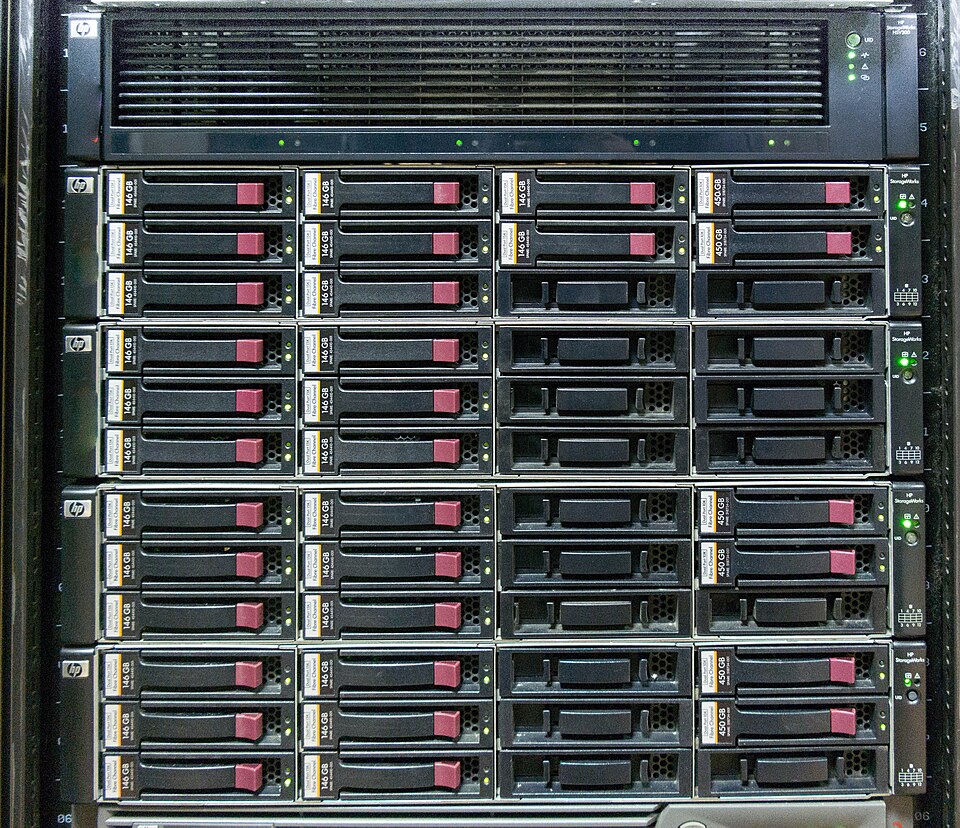
Systems such as HP EVA, IBM Storwize, and other high-end storage platforms use complex internal architectures in which physical drives are not simply a sequence of blocks distributed according to a predefined scheme.
This is one of the main reasons why professional data recovery from such systems is significantly more complex and, consequently, more expensive.
RAID does not necessarily mean “the data is split into blocks across the drives”
With classic RAID 0, RAID 5, or RAID 6, we can relatively easily visualize the logic:
Disk 1 → block A
Disk 2 → block B
Disk 3 → block C
Disk 4 → parity
With a specific configuration and known stripe size, the logical array can be reconstructed. With enterprise storage systems, however, this picture is often far too simplistic.
Instead of directly distributing logical blocks across physical drives, there may be
multiple layers of virtualization and translation between the user data and the physical blocks.
The device that the operating system sees as a single logical volume may be the result of a complex combination of:
- physical drives;
- disk groups;
- storage pools;
- extents;
- virtual disks;
- internal mapping tables;
- metadata;
- relocation;
- redundancy;
- parity;
- controller logic;
- cached operations;
- firmware-specific structures.
Therefore, the physical location of a given logical block cannot simply be calculated using a standard RAID formula.
The proprietary translation layer is the key
Some enterprise storage architectures have an additional layer that can be loosely referred to as a storage translation layer.
It determines where the individual parts of a logical volume are physically located. For example:
Logical Volume → Virtual Storage → Extent → RAID/Redundancy Group → Physical Disk → Physical location
This means that even if we have all the physical drives, we do not automatically have the information required to reconstruct them into the original logical volume.
The logic used by the storage system to organize the data must also be recovered.
This is where the real complexity begins.
ZOR, Reed-Solomon, and complex redundancy algorithms
In high-end storage systems, data protection can also be far more complex than the standard XOR parity used, for example, in classic RAID 5.
Depending on the architecture, various mathematical methods for redundancy and reconstruction may be used, including Reed-Solomon codes and other erasure coding approaches.
Their purpose is to allow information to be recovered even when certain physical components are unavailable.
With Reed-Solomon, for example, the process is not simply:
Data + XOR = Parity
Mathematical operations over finite fields are used to create multiple redundancy fragments, which can then be used to reconstruct missing portions of the data.
Some architectures also use Z-like/erasure coding mechanisms, different parity schemes, and proprietary algorithms.
Therefore, when dealing with a damaged array, it is not enough to know which drives are available. We also need to know exactly how the system generated and distributed the redundancy information.
The biggest problem – the data is not where you expect it to be
Imagine that we have 12 drives. At first glance, we might say:
“We have 12 drives – we will read them and reconstruct the RAID.”
With a complex storage system, however, this can be completely the wrong approach.
A single logical block from a given volume may be distributed through several levels of addressing, with no direct relationship between:
LBA of the logical volume
and
LBA of a specific physical drive.
In addition, different parts of the volume may be located in different places within the physical storage architecture.
That is why simply “putting the drives in order” often leads nowhere.
Why is standard RAID recovery software often not enough?
With standard RAID software, we can specify parameters such as:
- RAID 5;
- RAID 6;
- number of drives;
- stripe size;
- disk order;
- parity rotation;
- offset.
With enterprise storage, this may be only a small part of the information required. It is necessary to understand:
how the storage system created the logical volume and how it performed the translation to
physical drives.
If this mapping cannot be reconstructed, we may end up with a huge amount of physical data, but not the correct logical volume.
This is the fundamental difference between:
“we have the drives”
and
“we have access to the data.”
HP EVA – an example of a complex storage architecture
HP EVA (Enterprise Virtual Array) is a good example of why enterprise storage recovery should not be treated as ordinary RAID recovery.
With EVA, physical drives are part of a more complex virtualized storage architecture.
Logical disks and volumes are not simply standard RAID arrays that can be reconstructed using a few parameters.
There is metadata and internal information describing how the storage space is organized.
In the event of controller, metadata, or multiple-drive failures, recovery may require reconstruction of this internal organization.
IBM Storwize – another example
With IBM Storwize, the situation is similar, but with additional complexity due to virtualization.
Storwize can provide logical volumes built on physical storage infrastructure that is hidden behind multiple layers.
Therefore, the physical drives alone do not provide enough information to determine how the operating system originally accessed the data.
The correct mapping between:
Physical Storage → Storage Pool → Extents → Volume → Logical Blocks
must be reconstructed.
If this mapping is damaged, recovering the file system at the upper layer may be impossible, even if a large portion of the physical drives is technically readable.
Why does this make recovery expensive?
The cost is not simply due to the large number of drives.
The cost comes from the complexity of the analysis and reconstruction. With systems like these, it may be necessary to:
- diagnose each physical drive;
- extract firmware and metadata information;
- determine the actual configuration;
- analyze storage metadata;
- reconstruct the internal translation;
- determine the distribution of extents;
- reconstruct redundancy;
- work with damaged or missing drives;
- virtually reconstruct the storage system;
- verify the recovered data at the file-system and file levels.
This can require many hours or days of specialized work, and sometimes even the development of a specific methodology for the particular system.
“The drives are readable” does not mean “the data can be recovered”
This is one of the most common misconceptions. We may have:
12 out of 12 physical drives – readable.
And still:
0% usable files.
Why?
Because the physical drives are only the raw material.
We need to know how that material was organized by the storage system.
Just as having all the pieces of a book does not automatically mean that we know the correct order of its pages, having all the drives does not mean that we have the ready-to-use logical volume.
Enterprise storage recovery is a specialized field
Recovery from a standard RAID array and recovery from an enterprise storage system are two very different tasks.
With standard RAID, we can often work with a well-known algorithm. With enterprise systems, we may have:
RAID/Erasure Coding + Virtualization + Translation + Metadata + Proprietary structures
and each of these layers must be properly understood and reconstructed.
That is why professional data recovery from systems such as HP EVA, IBM Storwize, and other enterprise storage platforms requires not only specialized software, but also in-depth knowledge of the specific architecture, experience with similar cases, and appropriate equipment.
Recovery is not simply “rebuilding the RAID”
With complex storage systems, the most difficult part is often not reading the drives themselves.
The difficult part is understanding exactly what the system did with the data.
And when this information is missing or corrupted, recovery can become a complex reconstruction of an entire virtual storage architecture.
This is precisely why data recovery from enterprise storage systems is significantly more expensive than standard RAID recovery – it is necessary to recover not only the RAID, but also the logic that transforms multiple physical drives back into the original system and its data.